Facebook
 X
X
 Pinterest
 Copy Link
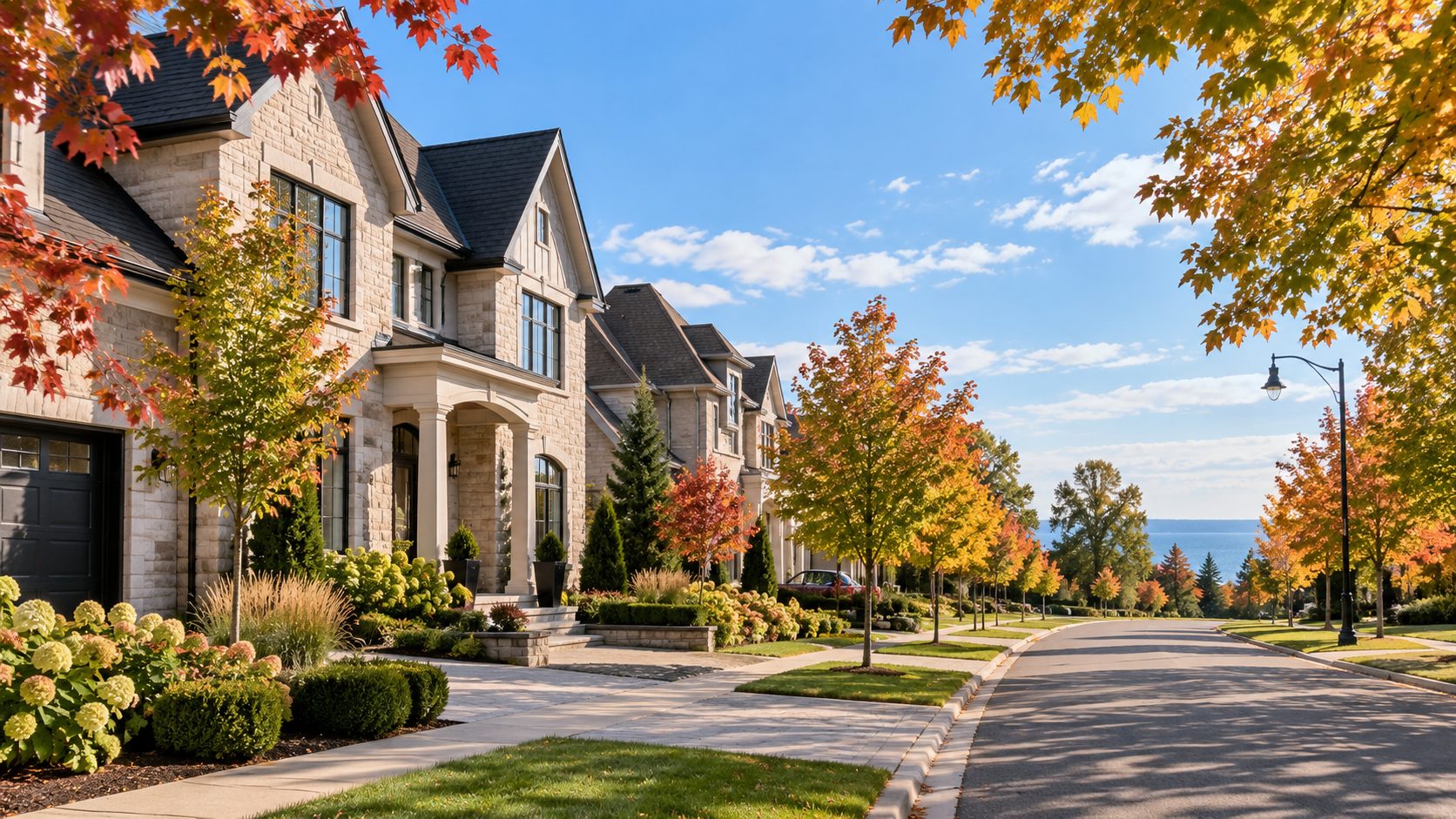
The fall real estate market is underway in Oakville and Burlington. Buyers have more choice, prices have softened in some areas, and sellers are facing a more balanced market. At the same time, mortgage rates and the economy continue to shape buyer decisions.
New data released by the Canadian Real Estate Association (CREA) on September 15 shows national home sales slipped 0.7% from July to August 2026. Actual sales were also 6.9% lower than August 2025. Meanwhile, new listings increased 3.3% month-over-month.
Here in Halton Region, conditions remain balanced. However, buyers continue to have room to negotiate, while sellers need to pay close attention to pricing.
So, what does the fall real estate market mean for buyers and sellers in Oakville and Burlington?
Canada’s Housing Market Remains Relatively Stable
Despite plenty of economic headlines, Canada’s housing market has been fairly steady in recent months.
According to CREA, national sales activity and price trends were largely unchanged for a fourth straight month in August. The national MLS® Home Price Index was unchanged from July. However, it remained 3% below August 2025.
The actual national average sale price was $668,219 in August, up 0.6% from a year earlier. It’s important to remember that an average price can be affected by the mix and location of homes sold, so it should not be viewed as the value of a typical Canadian home.
At the same time, sellers brought more properties to market. New listings increased 3.3% nationally from July.
As a result, the national sales-to-new-listings ratio declined to 49.1%, from 51.1% in July. CREA considers a ratio of roughly 45% to 65% generally consistent with balanced market conditions.
What Is Happening in the Halton Real Estate Market?
The local picture is especially important for anyone buying or selling in Oakville or Burlington.
According to the Oakville, Milton and District Real Estate Board (OMDREB), Halton Region remained in balanced market territory in August.
The average price of a single-family home across Halton was $1,405,216. That was down 0.7% from July and 3.3% from August 2025.
Townhouses and condominiums averaged $753,375. That was virtually unchanged from July but 10.8% lower than a year earlier.
Sales activity also slowed during the final part of summer. However, August is traditionally a quieter period, so September activity should provide a better indication of the direction of the fall market.
Oakville Real Estate Market
Oakville continues to command some of the highest home prices in Halton.
In August, the average price for a single-family home in Oakville was approximately $1.71 million, down 7.7% from August 2025.
At the same time, year-to-date single-family transactions were up 16.2%.
For Oakville townhouses and condominiums, the average August sale price was $838,861, down 13.5% year-over-year. New listings in that segment were also 44.7% lower than in August 2025.
These figures are a good reminder that one number doesn’t tell the whole story. Conditions can vary significantly by neighbourhood, property type and price range.
Burlington Real Estate Market
Burlington also remained a market where buyers and sellers need to look beyond the headline numbers.
The average price of a single-family home in Burlington was approximately $1.35 million in August, down 2.2% from a year earlier. Single-family transactions were also 12.6% lower year-over-year.
Burlington townhouses and condominiums averaged $675,332, down 12.3% from August 2025. Those properties spent an average of 48 days on the market.
As in Oakville, the numbers can look very different from one Burlington neighbourhood to another.
Buyers Have Negotiating Room This Fall
One of the most interesting local statistics is how many Halton homes are selling below their asking price.
In August, 81.3% of single-family homes sold below asking. For townhouses and condominiums, that figure reached 88.3%.
That doesn’t mean every seller will accept a significant discount. A well-priced home in a desirable neighbourhood can still attract strong interest.
However, the numbers suggest buyers should not automatically assume they need to pay the asking price.
Buyers may have an opportunity to negotiate on price, closing dates, conditions or other terms. The strength of that position will depend on the individual property and competing interest.
Sellers Need to Get the Price Right
For sellers, the fall real estate market requires a different strategy than the fast-moving markets we have experienced in previous years.
Pricing too high and waiting for the market to catch up can be risky.
Buyers currently have more time to compare properties. They can also see recent sales, price reductions and listings that have been sitting on the market.
Therefore, the first few weeks of a listing can be especially important.
A strong launch, professional presentation and realistic pricing can help a property stand out. Just as importantly, sellers should base their expectations on recent comparable sales, not simply on what a neighbour’s home sold for several years ago.
Mortgage Rates Remain an Important Factor
Interest rates are another part of the fall market story.
CREA noted in today’s release that fixed mortgage rates have increased as bond yields have risen. CREA’s senior economist also pointed to renewed uncertainty surrounding the future direction of variable rates.
That matters because even relatively small changes in mortgage rates can affect a buyer’s monthly payment and purchasing power.
Buyers should consider getting an updated mortgage pre-approval before making an offer. Someone who was pre-approved several months ago may be dealing with different rates or qualification numbers today.
Should Buyers Wait?
Trying to perfectly time the housing market is difficult.
For buyers, today’s market offers something that was often missing during highly competitive periods: time and negotiating room.
However, the right decision still depends on your finances, timeline and the type of property you’re looking for.
If the right home appears at a price that works within your budget, waiting solely because prices might move lower can carry its own risks. Inventory, mortgage rates and competition can all change.
Should Sellers List This Fall?
There are still buyers in the market, but they are being selective.
For sellers, that means preparation matters.
A home that shows well and enters the market at a price supported by recent comparable sales is in a much better position than one that starts too high and requires several reductions.
The strategy should also be specific to the property. The market for a detached home in one Oakville neighbourhood may behave very differently from the condo market in another area.
What to Watch in the Fall Real Estate Market
The next several weeks should give us a clearer picture of the fall real estate market in Oakville and Burlington.
I’ll be watching new inventory, sales activity, days on market and the gap between asking and selling prices in Oakville and Burlington. Mortgage rates and broader economic conditions will also remain important.
The key is to look at local, current data rather than relying only on national headlines.
If you’re considering buying or selling in Oakville, Burlington or the surrounding Halton Region, I can help you understand what is happening in the specific neighbourhood and property type you’re considering.
Thinking about making a move? Let’s talk about the numbers that matter for your situation.
Gary Lima
REALTOR®
CENTURY 21 Miller Real Estate Ltd., Brokerage
Market statistics are based on August 2026 data reported by CREA and OMDREB. Average prices can be affected by the type and location of properties sold and should not be interpreted as the value of an individual property. This information is provided for general informational purposes.